
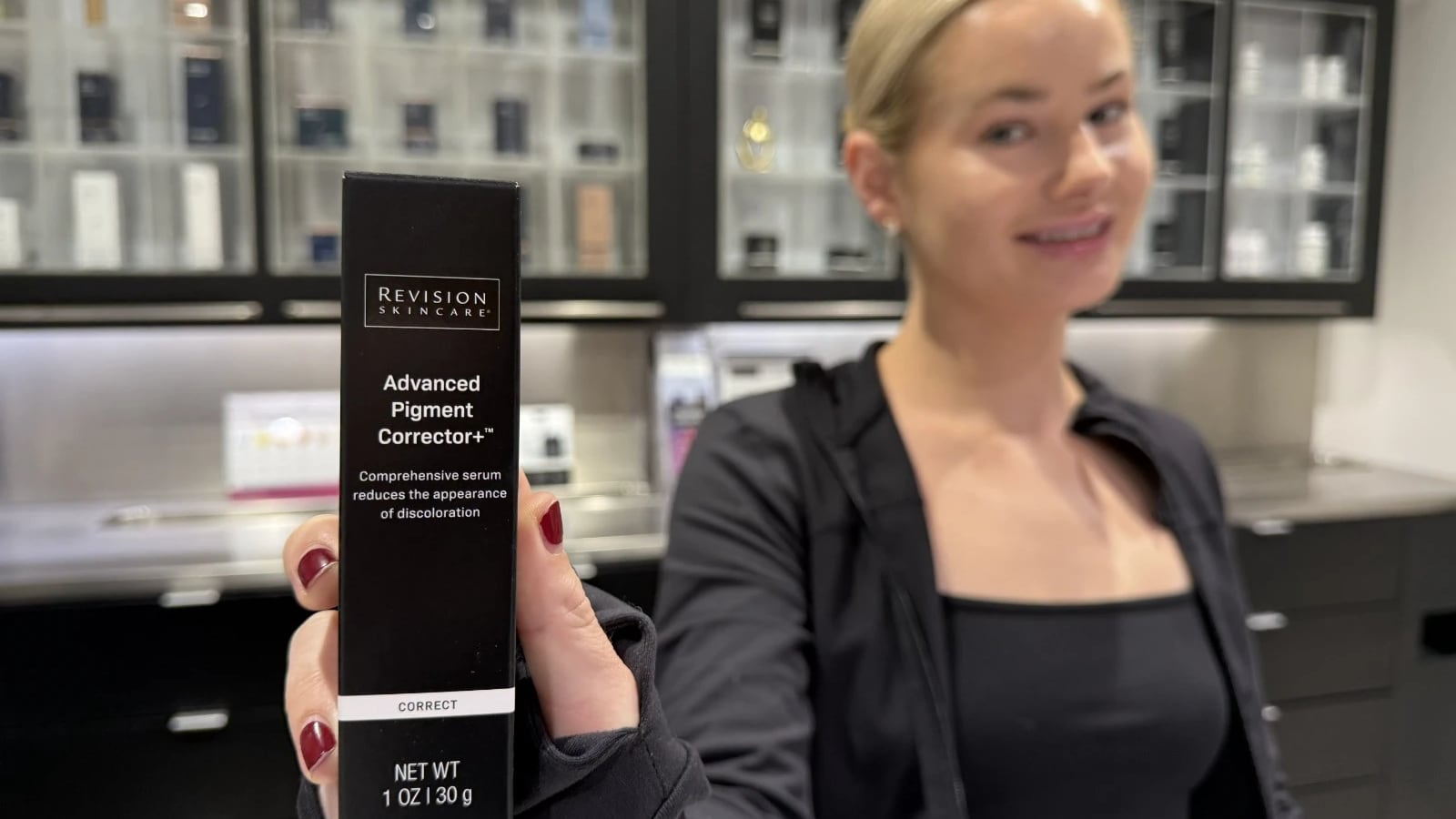
Advanced Pigment Corrector+ is a new hydroquinone-free serum from Revision Skincare, that may help improve the look of dark spots and uneven skin tone. Revision reports encouraging results in its own studies, listed as data on file. It may be worth discussing if sun-related discoloration bothers you, as long as you treat it as one part of a routine built on daily sun protection.
What Advanced Pigment Corrector+ is
Revision sells the product as a 1 oz (30 g) serum, labeled as a comprehensive serum that reduces the appearance of discoloration. Its professional brochure groups the formula into two parts.
- Correcting Complex: hydrolyzed yeast extract, tranexamoyl dipeptide-23, and acetyl hexapeptide-1, described as targeting visible discoloration.
- Longevity Complex: coffee seed extract, oxathiazolidine, and Palmaria palmata, described as helping maintain a more even look over time.
Revision also describes a patent-pending Exosomal Signaling Technology, which it says supports the skin's own cell-to-cell signaling. That is the company's description of how the product works. Exosomes are not listed among the key ingredients in the brochure, so the name alone should not be read as meaning the serum contains them. Ask to see the full ingredient list on current packaging, especially if you have sensitive skin or known allergies.
What Revision's data reports
Everything in this section comes from a Revision brochure written for healthcare professionals. Each result is footnoted "data on file" and "results may vary."
- 16-week results: Revision reports that 100% of subjects showed visible improvement by clinical grading in dark spot intensity, dark spot appearance, and skin tone evenness. Use was reduced to once daily during weeks 12 to 16.
- Weeks 12 to 16: Revision reports additional gains of 48% during this reduced-use period and describes the improvement as continuing rather than leveling off.
- Comparison with hydroquinone: Revision reports a split-face comparison against 4% hydroquinone using MASI, a scoring tool for melasma. It lists improvement of 25% versus 18% at week 2 and 63% versus 65% at week 4, with no significant difference between sides. This is Revision's report of its own comparison. It is not a claim that the serum treats melasma, which is a medical condition your provider should evaluate.
The brochure also lists percentage changes in markers such as melanin, oxidative stress, and an inflammatory signal called IL-1 alpha. It does not say whether those figures came from lab models or from people, so they should not be read as a prediction of what you will see in the mirror.
How to read these results
These figures are Revision's own data on file. The brochure does not give the number of participants or cite a publication, and the before-and-after images show individual subjects, so your results may vary. A provider can help you decide whether the product fits your skin and goals.
Why sun matters so much in Sarasota
No pigment product can keep up with unprotected sun. In a place where beach walks, boating, golf, and outdoor errands continue all year, daily exposure adds up. The American Academy of Dermatology (AAD) notes that UV rays reach your skin even on cloudy days and in winter, so a mild Florida November is not a day off from sunscreen.
For dark spots, the AAD's guidance is practical:
- Use a broad-spectrum, water-resistant sunscreen with SPF 30 or higher.
- Reapply every two hours, and right after swimming or sweating.
- Consider a tinted sunscreen with iron oxide, which the AAD says helps protect against the sun's visible light.
- Add shade and sun-protective clothing when you can, and avoid indoor tanning.
Timelines matter too. The AAD says a spot a few shades darker than your skin often fades within 6 to 12 months, while deeper discoloration can take years. A short trial followed by a sunny weekend is not a fair test of any routine.
Who may want to talk with a provider first
A serum is a poor way to find out what a spot actually is. Have a clinician look before you try to fade anything if a spot is new, changing, bleeding, itching, not healing, or unlike your other spots. Those can be warning signs that need a medical skin check, and a dermatologist may need to evaluate them promptly.
It also makes sense to ask first if you are pregnant or breastfeeding, have a history of irritation or pigment reactions, or use a prescription product for discoloration. Do not stop or swap a prescription on your own. If you have broad patches on the cheeks, forehead, or upper lip, ask whether melasma is a possibility, since the AAD notes that triggers can include sun, pregnancy, and some medications.
Questions to ask before you buy
- What kind of discoloration do I appear to have, and does this spot need a medical check first?
- Is this serum a reasonable fit for my skin type, tone, and sensitivity?
- How should it fit with my current retinoid, acid, or other active products?
- Should I pause it before a peel, laser, or light treatment?
- Which sunscreen should I pair with it for daily life in Florida?
- When should we review progress, and what would make us change course?
Follow the directions on the product and from your provider rather than copying a routine you saw online.
Pigment care at Harmony Med Spa
Harmony Med Spa in Sarasota carries Revision Skincare as part of its skincare product line, and our team can help you look at where a product like this fits. Some patients may also want to discuss a medical facial with Spectra skin analysis, chemical peels, or IPL photofacial treatments, depending on the concern and whether they are good candidates. If home care is the better first step, that is a useful answer too. Contact us to schedule a skincare consultation, and bring your current products and sunscreen so we can review them with you.
Frequently asked questions
What is Revision Advanced Pigment Corrector+?
It is a hydroquinone-free serum from Revision Skincare, sold in a 1 oz (30 g) size, that may help improve the look of dark spots, uneven tone, and discoloration.
Is Advanced Pigment Corrector+ a melasma treatment?
This article does not make that claim. Revision reports a comparison using a melasma scoring tool, but melasma is a medical condition, and a provider should evaluate it and discuss treatment options with you.
Where do the results come from?
They come from Revision's own data on file, as reported in its professional brochure. The brochure does not list the number of participants or cite a publication, and results may vary.
How soon might I notice a change?
Revision reports measurements at weeks 2, 4, 12, and 16, but results vary. Fading can be slow, and the American Academy of Dermatology says deeper discoloration can take much longer than a few months.
Do I still need sunscreen if I use it?
Yes. Sun exposure can darken discoloration. The American Academy of Dermatology recommends broad-spectrum, water-resistant SPF 30 or higher every day, with a tinted iron oxide formula helping against visible light.
Can I use it around peels or laser treatments?
Ask your provider first. Timing depends on your skin, your other products, and the planned treatment, so it is best to review your full routine before any procedure.
Sources and further reading
American Academy of Dermatology: How to fade dark spots in darker skin tones: https://www.aad.org/public/everyday-care/skin-care-secrets/routine/fade-dark-spots
American Academy of Dermatology: Melasma self-care: https://www.aad.org/public/diseases/a-z/melasma-self-care
American Academy of Dermatology: How to apply sunscreen: https://www.aad.org/public/everyday-care/sun-protection/shade-clothing-sunscreen/how-to-apply-sunscreen
Continue exploring
Personalized care in Sarasota
Ready to discuss your options?
A consultation connects the information in this guide to your health history, goals, timeline, and budget.
Ask About a Skincare Consultation